


The population of Delhi is growing every day as a result of the increased number of migrants and urbanization. As one of the fastest growing metropolitan cities in India, it does not have a proper sewage disposal and drainage system. Delhi is facing a severe problem of untreated sewage as only about 55% of homes in Delhi are linked to a proper sewerage system and the remaining 45% of waste is discharged into the Yamuna River.
According to facts published by the Delhi Jal Board (DJB) in 2012, only about 30% of all the sewage in Delhi is treated. It has been estimated that, on average, 3,296 million liters/per day of sewage is dumped in the Yamuna River. Delhi generates around 600 million gallons/per day of sewage, but the sewage treatment plants (STPs) set up in the city have a capacity to treat only 512.4 million gallons/per day of waste.
Many areas are not covered by current centralized sewerage systems and are in need of alternative decentralized solutions/fecal sludge management (FSM) as they are served through on-site sanitation systems.
The proposed project aims to demonstrate a small-scale, decentralized FSM solution in an urban, low-income, resettlement colony in Delhi (India’s capital) to focus on the growing concern of managing sewage by providing sustainable solutions. The project intends to identify similar low-income settlements, or resettlement colonies in the city, where the FSM solution can be considered for adoption and expansion by the Delhi government in the future. The priority of the project will be to install the FSM infrastructure at the identified location, and to demonstrate its application as a suitable solution for similar locations across Delhi.
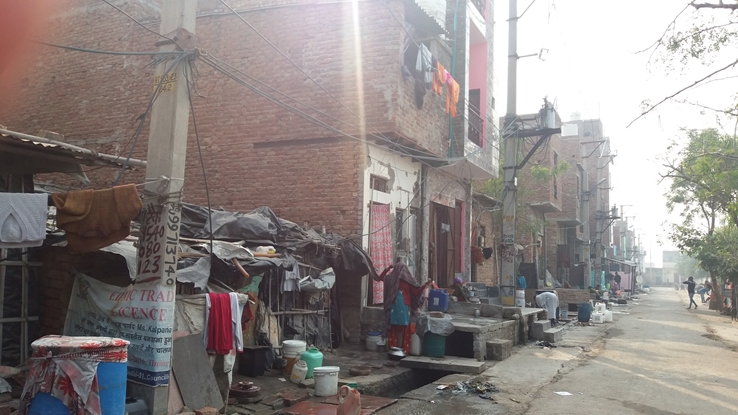
Photo: Centre for Urban and Regional Excellence (CURE), India
The objective is to ensure that the community assumes ownership and ensures continued usage of the FSM solution, thereby contributing to its sustainability. Through demonstration of this solution, an effort will be made to convince the Delhi state government to consider adoption of this solution in similar contexts elsewhere in the city.
The project will address contemporary innovations encompassing the entire sanitation value chain (containment, collection, transport and treatment/reuse) and develop a viable business model for successful demonstration of the FSM solution. The work will be undertaken in close coordination with relevant government agencies such as the Delhi Jal Board (DJB) and the Delhi Urban Shelter Improvement Board (DUSIB).

Photos: CURE
The primary goal of this project is to set up a decentralized, viable and sustainable FSM demonstration site in Savda Ghevra using a participatory approach to develop solutions for all components of the sanitation value chain.
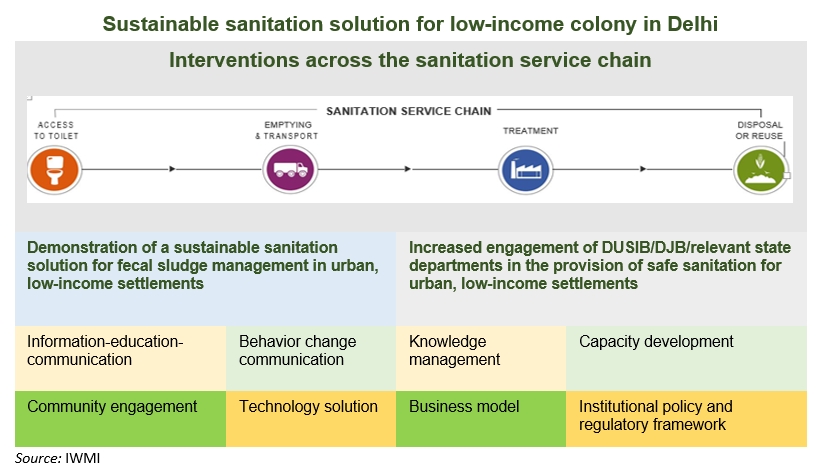
The proposed demonstration will initially target a complete FSM solution for a population of 36,000 people to address all the challenges (some of which have been described earlier) faced by the residents. Based on existing baseline data generated for Savda Ghevra, the challenges faced by the community will be assessed to demonstrate the following:
- A decentralized, modular design for a treatment plant will be phased out in a suitable manner with corresponding investments.
- A sustainable business model and plan for FSM in locations with no access to a sewerage network.
- The solution will address each component of the sanitation value chain.
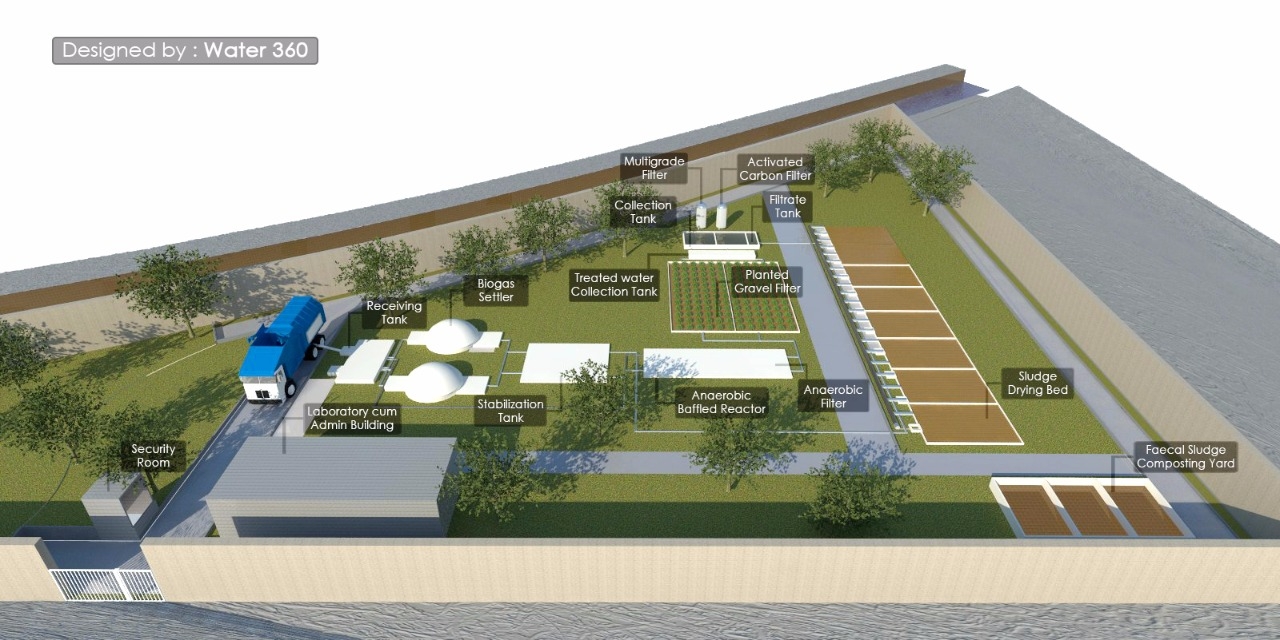
Image: Architectural view of the STP
Source: IWMI– Containment, collection, transportation and treatment for disposal or reuse, and treatment of grey water.
- Institutional framework to be established – A participatory approach involving all stakeholders to deliver a sustainable FSM solution by establishing an effective institutional model.
Out of the 6,960 households situated on plots in Savda Ghevra, the solution is proposed for a population of 36,000 covering 4,000 households in a staged approach.
The first phase of the project will cover 1,000 households with two CSTs, where each one will be connected to 500 households in two blocks of Savda Ghevra. The project will connect the proposed fecal sludge treatment plant (FSTP) with the existing CST, which is connected to 180 homes (against the actual design of 322 households) at present, and the 13 community toilet complexes in Savda Ghevra operated by DUSIB.
However, the above plan of a staged/modular approach will need to be tested after a full feasibility analysis is conducted and the situation on the ground is assessed, once the project is activated.
The proposed demonstration will translate well-researched FSM solutions into tangible and socially-relevant “on-the-ground” activities which could be used to test research assumptions related to performance, costs, community acceptance and other factors.
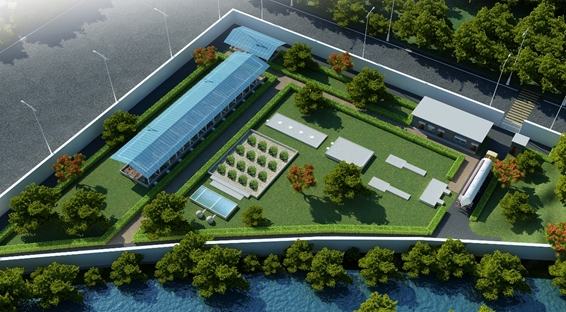
Source: IWMI